Solar Street Light Wattage vs Lumens: What Really Determines Brightness?
 By D.O Green Solar
- Published
- 10 min read
Wattage, lumens, battery Wh and panel rating each tell you something different. See what really decides how well a solar street light lights your site.
On this page
Ask most people how bright a solar street light is and they will quote a wattage. It is the biggest number on many listings, and it often appears in the product name. But wattage and brightness are not the same thing, and a solar street light has more than one wattage figure to confuse matters.
This article explains what each figure on a specification sheet actually measures, why a higher wattage does not automatically give you better lighting, and what decides how well a road, compound or car park is lit in practice. If you want a step-by-step guide to choosing a light, see how to choose solar street lights.
What wattage means on a solar street light
A watt (W) is a unit of power. On a solar street light, it can refer to at least three different things:
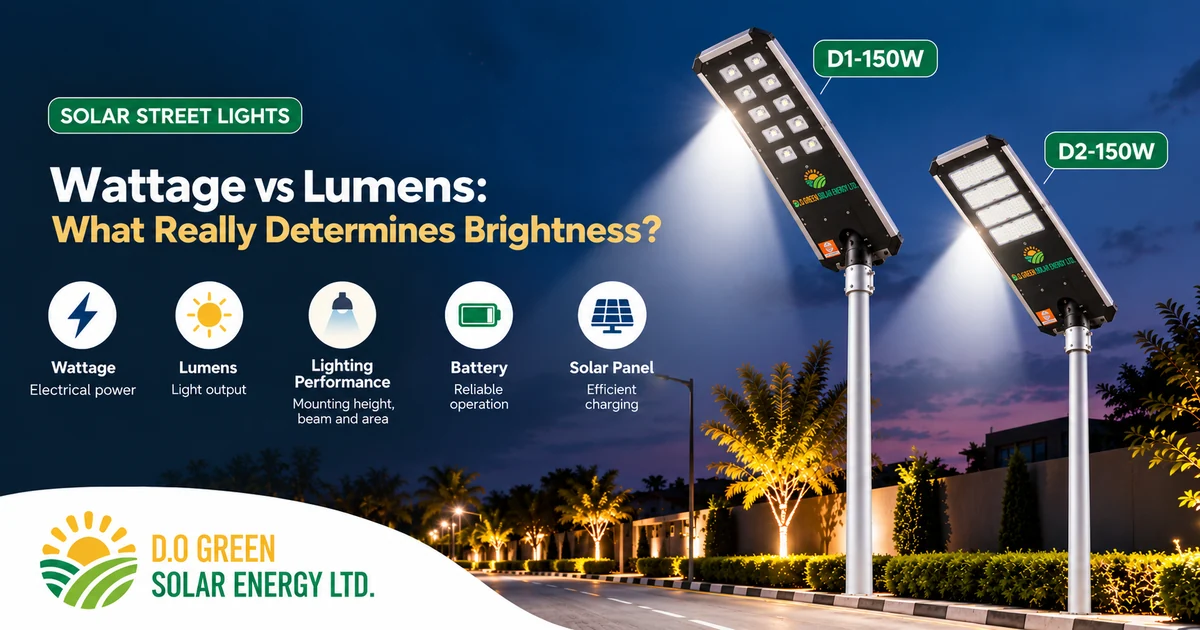
- The model name. Many products carry a wattage in their name. Our D1-150W and D2-150W are examples: the “150W” is a model designation, not a measurement of how much power the LED uses.
- The solar panel rating. This is the panel’s rated electrical output under test conditions. It tells you about its capacity to charge the battery, not about how much light comes out at night.
- The LED power. This is how much electrical power the light source draws when it is on. It is a separate figure from the panel rating and the model name, and it is not always listed.
Because the same unit can appear in three places, two listings that both say “150W” may be describing completely different things. Before you compare any two lights, check which wattage each figure refers to.
What lumens measure
Luminous flux, measured in lumens (lm), describes the total amount of visible light a light source gives out. Of the figures on a typical specification sheet, it is the closest to “how much light do I get”.
Lumens still have limits. A lumen figure tells you how much light leaves the fitting, not where it lands. Two lights with the same lumen rating can light the same road quite differently, depending on how they are mounted and how the light is spread.
You may also see lux (lx) mentioned. Lux measures how much light actually falls on a surface, such as the road or a footpath. Lux depends on the light’s output, its height, its distribution and the distance from the fitting, so it is a property of an installation rather than a product on its own.
Why higher wattage does not automatically mean better lighting
There are three common reasons why a bigger wattage can mislead:
- It may not be the LED power at all. If the wattage is a model name or a panel rating, it says nothing direct about light output.
- LEDs differ in efficiency. Even when the figure is the LED power, two light sources can produce different amounts of light from the same power. That is why the lumen figure matters more than the wattage when you compare brightness.
- Output is not the same as usable light. A light that sends much of its output into the sky, onto walls or beyond the road edge can look bright from a distance but leave the ground poorly lit.
The practical rule is simple: compare lumens for light output, and read each wattage figure for what it describes: a product name, a panel’s charging capacity or the LED’s power use.
What decides usable lighting on the ground
Once a light leaves the factory, its lumen rating is fixed. How well it lights your site is not. These factors make the difference.
Mounting height
Mounting a light higher spreads its output across a wider area, while mounting it lower concentrates light into a smaller patch. Neither is automatically better: the right height depends on the area you need to light and the spacing between poles. For the D1-150W and D2-150W, the recommended installation height is 6–8 m.
Light distribution
Street lights are designed to shape their light, not just emit it. The pattern of how light leaves the fitting decides whether it stretches along a road, spreads into a wider area or falls mainly beneath the pole. When a supplier provides distribution information for a product, ask what kind of area it suits. If they do not, ask how they would position the lights for your layout.
Road width and layout
A narrow estate road, a wide access road and an open car park ask different things of the same light. Wider areas usually need more careful positioning, sometimes with poles on both sides or more units, to avoid dark patches between them. Bends, junctions, trees and buildings also affect where light can reach.
Pole spacing
Placing lights too far apart leaves dark gaps, however bright each unit is. Placing them too close can waste output and budget. There is no single spacing that suits every site. It depends on height, distribution, road width and how evenly you want the area lit, so base it on your actual plan.
Battery and panel: why they matter for operation, not brightness
The solar panel and battery do not make a light brighter. They decide whether it can keep working the way it was designed to, night after night.
- The solar panel collects energy during the day. Its rating describes its capacity under test conditions. The energy it actually collects depends on sunlight, weather, shading and how the panel is positioned.
- The battery stores that energy for the night. Its capacity, in watt-hours (Wh), describes how much energy it can hold. Capacity alone does not tell you how long a light will run: its operating settings and the energy available after charging also matter.
The D1-150W and D2-150W show this clearly. Both state the same light output, 15,000 lm, yet their panels and batteries are different:
| Specification | D1-150W | D2-150W |
|---|---|---|
| Luminous flux | 15,000 lm | 15,000 lm |
| Solar panel | 160W mono | 150W mono |
| Battery capacity | 788Wh | 192Wh |
| Colour temperature | 6500K | 8000K |
D1’s larger battery does not make it brighter than D2. The two models differ in how much energy they can collect and store, which is a question of operation, not of lumens. Colour temperature does not change brightness either: D2’s 8000K looks cooler and bluer than D1’s 6500K, but it is not a higher light output.
How to read a solar street light specification sheet
When you compare any two products, take each figure for what it is:
| Figure | What it tells you | What it does not tell you |
|---|---|---|
| Wattage in the model name | Which product it is | Light output or LED power |
| Solar panel (W) | Charging capacity under test conditions | How much energy your site will collect |
| Battery (Wh) | How much energy can be stored | A guaranteed runtime |
| Luminous flux (lm) | Total light output | Where the light lands or how even it is |
| Colour temperature (K) | How warm or cool the light looks | Brightness |
| Installation height (m) | How the unit is meant to be mounted | Spacing for your site |
A few habits help:
- Ask which wattage a figure refers to whenever it is not labelled.
- Compare lumens with lumens, and Wh with Wh. Be wary of comparing a lumen figure on one listing with a wattage on another.
- Treat runtime and coverage claims as conditional. Ask what sunlight, settings and layout they assume.
- Ask for the documentation behind a figure if it looks unusually high for the size of the unit.
The full documented figures for our two models are on the D1 and D2 specifications page.
Practical examples in Nigeria
These examples show how the same principles play out on different sites. They are illustrations of the questions to ask, not a lighting design for any particular property.
A residential estate road
Most estate roads are narrow, lined with walls and gates, and used by both cars and people on foot. Here, consistent light along the road and at junctions usually matters more than a very high output at each pole. Mounting height, positions that avoid shade from trees and boundary walls, and a sensible spacing do most of the work. Our guide to solar street lighting for residential estates covers how to plan each part of an estate.
A wider access road
A road leading into a school, factory or farm may be wider and busier than an estate road. A single row of lights along one edge can leave the far side darker, so the layout may need poles on both sides or closer spacing. A higher wattage in the product name does not fix a layout that leaves gaps.
A car park or commercial frontage
Car parks and the frontage of a shop, filling station or warehouse are open areas rather than long strips. People need to see vehicles, kerbs and faces. Light that spills onto walls or beyond the boundary is wasted, while dark patches between bays make the space feel unsafe. Positioning around the edges and access lanes usually matters more than chasing the biggest number on a listing.
In each case, the question to bring to a supplier is not “which light has the highest wattage?” but “how would you light this area, and why?”
Frequently asked questions
Is a 150W solar street light brighter than a 100W one?
Not necessarily. The wattage may be a model name, a panel rating or the LED power, and none of them measures light output. Compare the lumen figures instead.
Does “150W” mean the LED uses 150 watts?
For the D1-150W and D2-150W, no. The “150W” is part of the model name. For their panels, use the separate ratings: 160W on D1 and 150W on D2.
Which is brighter, D1-150W or D2-150W?
Both state the same luminous flux of 15,000 lm. They differ in panel rating, battery capacity and colour temperature. D2’s 8000K looks cooler than D1’s 6500K, which is a difference in appearance, not in light output.
Does a bigger battery make a light brighter?
No. Battery capacity describes stored energy, which affects operation rather than light output. How long a light runs also depends on its settings and how much charge the panel can collect.
How many lumens do I need for my road or compound?
There is no single answer, for the reasons covered under what decides usable lighting on the ground. Be cautious of any figure offered without seeing your site. Share a plan or photos with your supplier and ask how they would position the lights.
Can I compare lux figures between products?
Lux describes light falling on a surface in a particular arrangement, so a lux figure only means something alongside the height, spacing and layout it was measured or calculated for. Lumens are the figure to compare between products.
Comparing your options
The figures on a solar street light listing are useful once you know what each one measures. Lumens tell you about light output, the panel and battery tell you about operation, and your site’s layout decides how much of that light ends up where you need it.
If you are weighing up options for a project, compare the D1 and D2 specifications, read about installation, or contact us by phone or WhatsApp to talk through your site.
About the Author