How to Choose Solar Street Lights for Your Property in Nigeria
 By D.O Green Solar
- Published
- 9 min read
Choosing solar street lights for a home, estate or business in Nigeria? Check sunlight, panel and battery figures, brightness, height, poles and warranty.
On this page
Choosing a suitable solar street light starts with the place it needs to light. A light that suits a short driveway may be a poor fit for an estate road, and a unit that works well in open ground can struggle beside a tall building that shades its panel for half the day. Before you compare models or prices, it helps to be clear about your property, how much sun each mounting point gets and what the product figures actually tell you.
This guide walks through those decisions in order. It is written for homeowners, estate managers, businesses and anyone buying lights for a project in Nigeria.
Start with your property and what needs lighting
If you can, walk the property after dark and note where light is actually needed, such as dark stretches of road, unlit corners and places where people wait or park. If a night visit is not practical, mark the areas used after dark on a site plan or on daytime photos. Think about:
- Who uses the space. Vehicles on an estate road, people walking between buildings, customers in a car park and security staff at a gate all need different things.
- The areas to cover. Entrances, access roads, walkways, parking areas, perimeter fences and shared spaces are common starting points.
- Where a light can be mounted. Each light needs a pole or fixing point, and ideally a position where its solar panel is not shaded.
- What is already there. Existing poles, walls or old fittings may affect the plan, but do not assume they can be reused without checking.
A simple sketch or a few photos of these areas will make every later step easier, including any conversation with a supplier.
All-in-one or separate components?
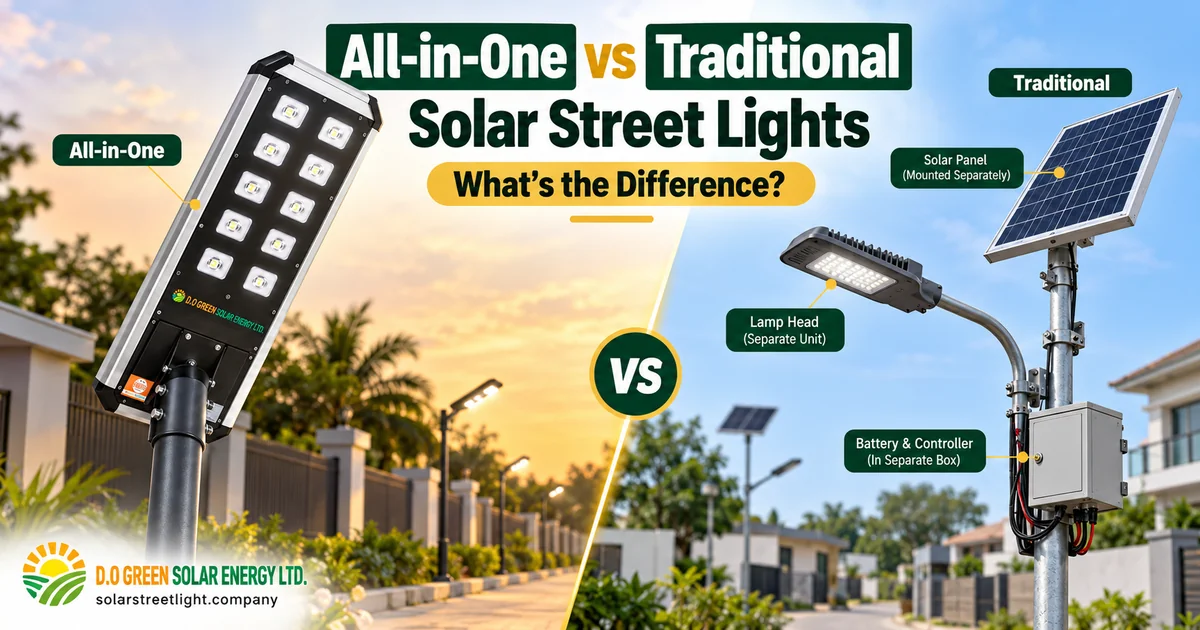
Solar street lights come in two broad designs. In an all-in-one solar street light, often called an integrated solar street light, the solar panel, LED light and battery are built into a single unit. In a separate (or split) system, the panel, battery and lamp are installed as individual parts and connected on site.
For many properties, the all-in-one design keeps things simple: there is one unit to mount at the top of each pole and no separate battery box or cabling between parts. The trade-off is that the panel sits wherever the light sits, so each mounting position has to suit both jobs: lighting the right area and catching the sun.
Our D1-150W and D2-150W are both all-in-one solar street lights, so the rest of this guide uses that design as its reference.
Check the sun at every mounting point
A solar light can only use the energy its panel collects during the day. That makes sunlight the first thing to check at each proposed position, before you choose a model.
Look for anything that could shade the panel for part of the day:
- Tall buildings, perimeter walls and water tanks
- Trees, including ones that will grow taller
- Signboards, roofs and other structures close to the pole
Shade that only falls on a position for a few hours can still reduce the energy available. If a proposed position is heavily shaded, look for another spot nearby that has a clearer view of the sky and still lights the area you need, rather than accepting weaker charging. Keep the panel clean as well: dust and dirt on its surface can reduce how much light reaches it. Follow the product manual for the correct panel orientation and mounting.
Read the specifications, not just the model name
Product names can be misleading. A wattage in a model name is not always the panel rating or the power used by the LED, so compare the individual figures instead.
For our two models, the 150W in each name is a model designation. Here are their documented specifications:
| Specification | D1-150W | D2-150W |
|---|---|---|
| Solar panel | 160W mono | 150W mono |
| Battery capacity | 788Wh | 192Wh |
| Luminous flux | 15,000 lm | 15,000 lm |
| Colour temperature | 6500K | 8000K |
| Protection rating | IP65 | IP65 |
| Recommended installation height | 6–8 m | 6–8 m |
The full comparison, with an explanation of each figure, is on our D1 and D2 specifications page. Here is what to look for when you compare any solar street lights.
Solar panel rating
The panel rating describes its rated electrical output under test conditions. It tells you about the panel’s capacity to charge the battery, but the energy it actually collects still depends on sunlight and shading at your site.
Battery capacity in Wh
Watt-hours (Wh) measure stored energy, which makes them more useful for comparison than a battery label without units. Capacity alone does not tell you how long a light will run each night, though. That also depends on the light’s operating settings and how much charge the panel can collect. Ask the supplier for the documented working schedule and the conditions it assumes.
Brightness and colour temperature
Luminous flux, in lumens (lm), describes the total amount of visible light a unit gives out. It does not tell you how evenly a road or yard will be lit; that also depends on mounting height, pole positions and the shape of the area.
Colour temperature, in Kelvin (K), describes how warm or cool the white light looks. A higher figure means a cooler, bluer white. It does not mean a brighter light.
Protection rating
An IP65 rating means the unit is protected against dust and water jets. It is not a rating for immersion, so it does not mean the light can sit under water. Check that the installation conditions match the product instructions.
Plan mounting height and pole positions
Mounting height affects how the light spreads across the ground. Both D1-150W and D2-150W have a documented recommended installation height of 6–8 m. Treat that as guidance for these models rather than a universal pole height for every solar light.
The distance between poles depends on your site: the width of the road or space, the layout, obstacles and how evenly you want the area lit. Plan the light, bracket and pole together, so the pole height and fixing suit the unit you choose.
If you already have poles, their condition and compatibility need to be checked before they are included in the plan. If you need new ones, our solar street light poles page explains the height, material, finish and mounting details to bring to the conversation.
Choose between models for your site
With your sunlight, height and layout notes in hand, you can compare models sensibly. D1-150W has the larger panel and battery of our two models: a 160W panel and a 788Wh battery, against a 150W panel and a 192Wh battery on D2-150W. They also differ in colour temperature, at 6500K and 8000K. Both state 15,000 lm.
A larger panel or battery does not, by itself, make one model the right choice for every property. What matters is how well the model suits the area you need to light, the sunlight available at each position and how the lights will be used. Ask the supplier to confirm the details for your project before you commit.
Plan the installation and quantity
Once you know the positions, you can work out how many lights you need and what the installation involves. An installer will usually want to know:
- The project location, and the town or city
- What each area is used for and how many lights you are considering
- Existing poles or fixing points, with photos if possible
- Access to the site and any shading at the proposed positions
Our installation page sets out how we plan supply and installation, from your first call to an agreed scope and quotation. Installation availability depends on the project location, so mention where the site is from the start.
For larger projects, such as an estate, several business locations or stock for resale, the wholesale page covers bulk enquiries for both models.
Understand the warranty before you buy
A warranty period is only useful if you know what it covers. Before you buy any solar street light, confirm:
- How long the warranty lasts and what parts it covers
- What is excluded
- How a claim is made, and what you need to keep, such as proof of purchase
Our D1-150W and D2-150W carry a stated warranty of 36 months, subject to the applicable terms and exclusions, including artificial damage. Ask us to confirm the full terms before you place an order.
Questions to ask any supplier
Whichever supplier you speak to, these questions will help you compare offers fairly:
- What are the solar panel rating and battery capacity in watt-hours?
- What light output (in lumens) and colour temperature are stated?
- What working schedule does the light use, and under what conditions?
- What mounting height is recommended, and what pole and bracket does the unit need?
- Can you supply poles, and is installation available at my location?
- What does the warranty cover, what does it exclude and how are claims handled?
- What exactly is included in the quotation: lights, poles, brackets, delivery or installation?
A supplier who answers clearly and in writing makes it much easier to compare quotations on equal terms.
Choosing a supplier in Nigeria
Price matters, but it is only one part of the decision. Look for a supplier who publishes clear specifications, explains what a figure does and does not mean, and asks about your site before recommending a model. It also helps to discuss the lights, poles and installation with the same supplier, so the light, bracket and pole are planned together. Whoever you choose, confirm in writing exactly what each quotation includes.
We are based in Lagos and supply all-in-one solar street lights. We can also discuss poles for your project and, where it is available at your location, installation. To discuss your property, call or WhatsApp us on +234 70 8892 1215. Tell us where the lights will go, what needs lighting and roughly how many units you have in mind, and we can talk through the options with you.
About the Author