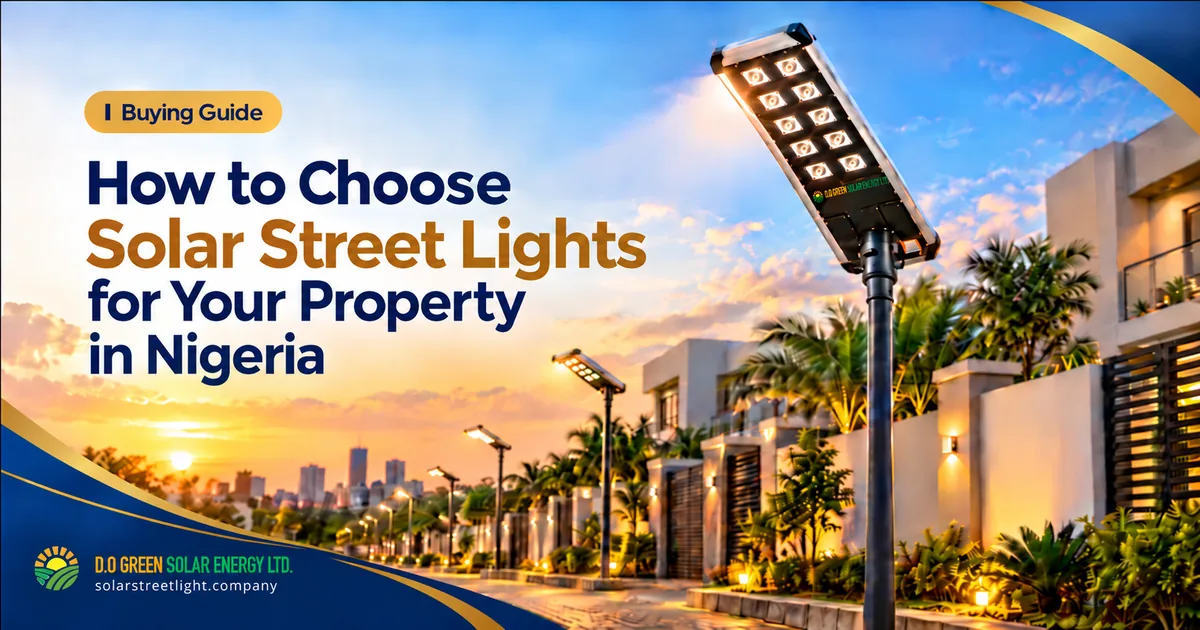
All-in-One vs Traditional Solar Street Lights: What's the Difference?
 By D.O Green Solar
- Published
- 8 min read
Compare all-in-one and split solar street lights: how each is built, installed and positioned, and which suits estates, roads and businesses in Nigeria.
On this page
When you start comparing solar street lights, you will usually come across two designs. Some suppliers offer all-in-one units, where everything sits in one housing at the top of the pole. Others offer traditional split systems, where the solar panel, lamp and battery are separate parts connected by cables.
Both designs do the same basic job, so the choice comes down to your site and how you want the project to run. This article explains how each design is built, what the difference means once the poles go up, and how to think about it for estates, roads, business premises and larger orders. If you are at an earlier stage, our guide on how to choose solar street lights in Nigeria covers the wider decision.
The short answer
An all-in-one solar street light, also called an integrated solar street light, combines the solar panel, LED lamp and battery in a single unit that mounts on the pole as one piece.
A traditional split system keeps those parts separate. The panel, the lamp head and the battery (usually with its controller) are mounted individually and wired together on site.
Both charge a battery from sunlight during the day and use it to run the light after dark. Neither design is automatically the better one. They differ in how many parts there are, how they are installed and how much freedom you have in placing the panel.
How an all-in-one solar street light is built
In an all-in-one unit, the solar panel sits on one face of the housing and the LEDs on the other, with the battery inside. The whole unit fixes to the pole in one piece, so each pole carries a single item and there are no cables to run between separate parts.
The catch is that the panel goes wherever the light goes. Every mounting position has to do two jobs at once: put light where people need it and give the panel a clear view of the sun.
Our D1-150W and D2-150W are both all-in-one solar street lights.
How a traditional split system is built
A split system is assembled from separate components. A typical set-up includes:
- a solar panel on its own bracket, usually at or near the top of the pole
- an LED lamp head on an arm
- a battery and controller in an enclosure, mounted on the pole or nearby, depending on the design
- cabling to connect the parts
Because each part is positioned on its own, the installer can angle the panel separately from the lamp. The cost of that freedom is more parts to mount, more connections to make and more items to keep track of. Designs vary from one manufacturer to another, so check exactly what a given split system includes.
All-in-one vs split: side-by-side comparison
The table below compares the two designs in general terms. Individual products differ, so treat it as a starting point rather than a rule.
| Feature | All-in-one | Split system |
|---|---|---|
| Main parts | One unit | Panel, lamp, battery box |
| Mounted as | A single piece | Separate parts |
| Wiring between parts | None on site | Cables on site |
| Panel position | Moves with the light | Set separately |
| Items per pole | One | Several |
| On a quote | One set of figures | Figures for each part |
What the difference means on site
Sunlight and shade at each pole
Many compounds and estates have walls, trees, water tanks and neighbouring buildings close to the places that need light. With an all-in-one unit, the panel cannot be moved away from the light, so each mounting point needs its own shade check across the day. If a position is shaded for long periods, the usual answer is to move the pole or rethink the layout before ordering.
A split system can sometimes place the panel where it catches more sun while the lamp stays where light is needed, within the limits of the pole, bracket and cable run. Whichever design you choose, check the sun at every mounting point before you settle on a model.
Installation and wiring
Fitting an all-in-one light means lifting and fixing one unit per pole, then setting it up according to the product instructions. A split system means mounting the panel, lamp and battery enclosure, then running and connecting the cables between them. That is routine work for experienced installers, but more parts and connections mean more to check at handover.
Either way, the pole and arm must suit the light being fitted. Our solar street light poles page explains what to share when asking about poles, and our installation page covers how we discuss supply and installation for a project. Availability depends on the project location.
Ordering and keeping track of parts
On a project with many poles, an all-in-one design keeps the order simple: one unit per pole, plus the poles and fittings. A split system adds panels, lamps, batteries, controllers and cables to count, deliver and match up. Whichever you choose, keep a record of which model is installed at each position. It makes later questions about settings or warranty much easier to answer.
Which design suits your project?
There is no single answer, but these examples show the questions worth asking for common Nigerian projects.
Estates and residential compounds
Estate roads often have many similar pole positions. Repeating the same all-in-one unit along a road keeps ordering and installation consistent from one pole to the next. Even so, the sun can vary along the same road, so check each position rather than assuming the whole street is alike. In smaller compounds with high walls and mature trees, the shade check matters most. If an important spot is heavily shaded, discuss the options before you order.
Roads and access routes
Access roads into estates, schools, farms and industrial sites are often fairly open, which makes it easier to find positions where the panel gets good sun. Stretches lined with trees or buildings need closer checks. Plan pole heights and spacing at the same time: both D1-150W and D2-150W have a recommended installation height of 6–8 m.
Business premises and car parks
Forecourts, car parks, warehouse yards and shop fronts usually need light where people walk, park and load after dark. These areas are often close to buildings, canopies and boundary walls that shade part of the day. Mark the areas that need light, then check whether a pole in each spot will also give the panel the sun it needs.
Multi-site and wholesale projects
If you are buying for several sites, or supplying lights to others, a consistent all-in-one model can make quantities easier to plan and deliveries easier to sort. Outline the requirements for each location separately, including the number of poles and any shaded positions, so the model and quantity discussion stays specific. Our wholesale page explains how to start a bulk enquiry.
Comparing quotes for either design
Whatever design you are offered, compare the documented figures rather than the wattage on the label. For each option, look for:
- the solar panel rating
- the battery capacity in watt-hours (Wh)
- the light output in lumens
- the ingress protection (IP) rating
- the recommended mounting height
- what the warranty covers and excludes
For a split system, ask for those figures for each component and confirm what the quote includes, such as poles, arms, cables and the battery enclosure. Our first guide has a fuller list of questions to ask any supplier.
Where D1-150W and D2-150W fit
Our range is all-in-one: D1-150W and D2-150W are both all-in-one solar street lights. This article describes split systems only for comparison.
Both models state a light output of 15,000 lm, carry an IP65 rating and have a recommended installation height of 6–8 m. They differ in panel, battery and colour temperature:
- D1-150W: 160W monocrystalline panel, 788Wh battery, 6500K
- D2-150W: 150W monocrystalline panel, 192Wh battery, 8000K
The stated warranty for both is 36 months, excluding artificial damage. The full figures and warranty notes are on our specifications page.
If you are not sure whether an all-in-one light suits your site, contact us with the locations you want to light, the number of poles and any positions that are shaded for part of the day.
About the Author