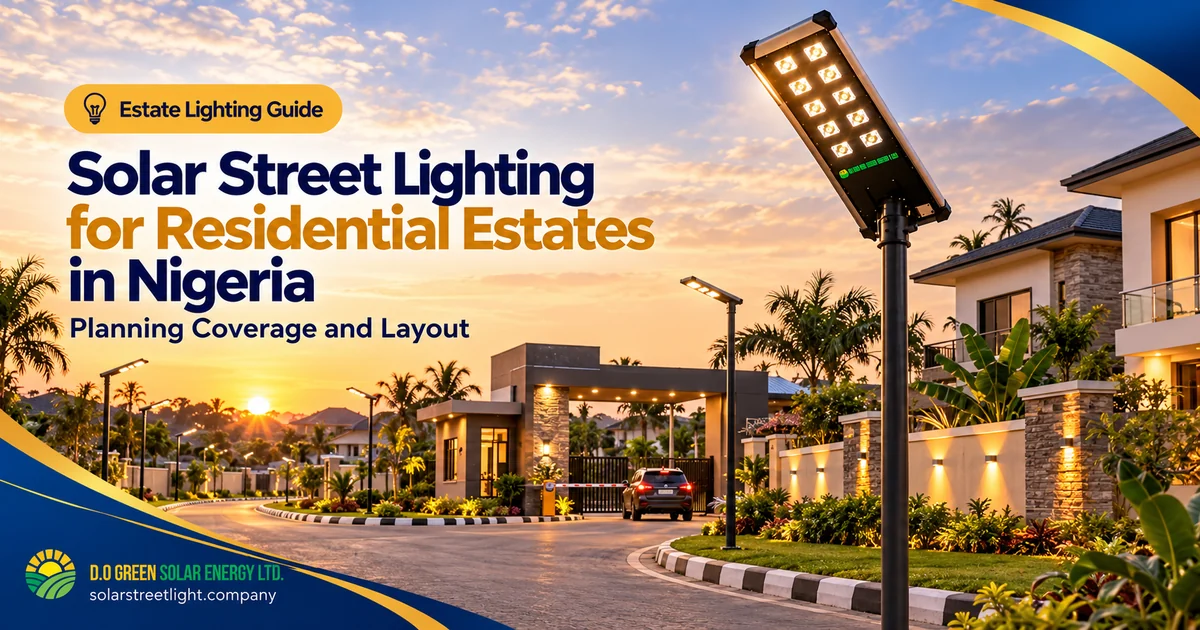
Solar Street Lighting for Residential Estates in Nigeria: Planning Coverage and Layout
 By D.O Green Solar
- Published
- 11 min read
Plan solar street lighting for a residential estate in Nigeria: entrances, internal roads, walkways, parking, shared spaces, security points and future phases.
On this page
A residential estate is not one long road. It is a gate, a few main roads, quieter side streets, footpaths, parking bays, a playground or event ground, and a perimeter that someone has to watch at night. Each of those places is used differently after dark, so each needs its own thought when you plan solar street lighting.
This guide is for estate developers, facility managers, residents’ associations and landlords who want to work out where lights should go across an estate and why. It focuses on the layout. If you are still comparing products, our guide on how to choose solar street lights covers that, and our article on what to consider before installing covers site surveys, ground conditions and installation day.
Think in zones, not just pole counts
The quickest way to plan an estate is to divide it into zones and ask the same questions of each one:
- Who uses it after dark? Cars, motorcycles, residents on foot, children, domestic staff, security guards or delivery drivers.
- What do they need to see? The road edge, a kerb or speed bump, the face of someone approaching, a parked car, a step or a drainage channel.
- When is it busiest? Evening returns from work, early-morning departures, weekend events or late-night patrols.
- Where can a light stand? A verge, a median, a corner plot, a wall or an existing pole, with a clear view of the sun for the panel.
A zone map turns a vague request (“we need street lights for the estate”) into something you can discuss, price and phase. It also stops the common habit of spacing poles evenly along every road and hoping the important corners are covered.
Estate entrances and gatehouses
The entrance is where the estate meets the outside world, and it usually deserves the most attention. Vehicles slow down or stop here, guards check visitors and pedestrians walk in from the main road.
When you plan the entrance, think about:
- The approach road outside the gate. Drivers and guards both benefit from seeing who is waiting before the gate opens. If the approach is on a public road, check who is responsible for that land before you put a pole there.
- The gate itself and the barrier area. Guards need to see faces, vehicles and number plates. A light placed only behind the gatehouse can leave the guard looking out into darkness.
- The pedestrian gate. Many estates have a side gate for people on foot. It is often forgotten because it is narrow, yet it is used heavily in the evening.
- The first stretch inside. The first junction or roundabout past the gate is where traffic spreads into the estate, and it is a natural place for the next light.
Entrance features such as a signboard, landscaping or a decorative wall can shade a panel or block light, so place poles with the finished design in mind rather than the bare site.
Internal roads
Internal roads carry most of the estate’s night-time movement, but they are not all the same.
Main roads and spine roads
The main road from the gate to the centre of the estate usually carries the most cars and the most people walking home. Plan this first. Pay attention to junctions, roundabouts, bends and speed bumps, because those are the points where drivers need to see what is ahead and pedestrians are most likely to cross.
Side streets and closes
Quieter streets and cul-de-sacs still need light, particularly where they end. A dark close at the back of an estate is exactly the kind of place residents avoid walking at night. Lights at the entrance to the close and at the turning area at its end often matter more than lights halfway along it.
Which side of the road?
On narrow estate roads, poles on one side may be enough. On wider roads, or where buildings and trees shade one side, positions may need to alternate or move to the sunnier side. There is no single spacing figure that suits every estate: the right distance between lights depends on road width, mounting height, the layout and how evenly you want the area lit. Your supplier or installer should base it on your actual plan.
Walkways and footpaths
Footpaths between streets, along drainage channels or towards a shared facility are easy to leave out because cars do not use them. But they are where people feel least safe after dark, and where trips and falls happen.
Look for:
- shortcuts residents actually use, even if they are not on the plan;
- steps, slopes and changes of surface;
- drainage channels and culvert crossings alongside or across the path;
- hedges and walls that create blind corners.
Some footpaths are too narrow, or too enclosed by trees and buildings, for a pole-mounted all-in-one unit to work well. In that case, it may make more sense to light the two ends of the path from the road positions and keep the path itself clear and open.
Parking areas
Shared parking, visitor bays and the parking area outside a clubhouse or shop need light for two reasons: people walking between cars, and the security of the cars themselves.
Plan positions around the edges and access lanes rather than in the middle of bays, so poles do not become obstacles or get hit by reversing vehicles. Think about where drivers will stand to unlock their cars, and whether the route from the parking area to the nearest footpath or building is also lit. A bright car park with a dark walk home only solves half the problem.
Communal spaces
Many estates have a playground, a sports court, a garden, an event ground, a place of worship, a clubhouse or a waste collection point. Each is used at different times:
- Play areas and gardens are mostly used in the early evening. Light the paths around them and the entrance, not just the centre.
- Event grounds and courts may be busy late at night on weekends. Agree with the estate committee how they are used before you decide on positions.
- Waste collection points and utility areas are visited by residents and service vehicles, often early in the morning when it is still dark.
Communal spaces often have trees planted for shade, which is good for residents and bad for solar panels. Check where the shade falls through the day, and remember that young trees will grow.
Security points and the perimeter
Security teams know where problems happen. Before you finalise the plan, walk the estate with the head of security or the guards on the night shift and ask them:
- where they patrol and where they stop;
- which stretches of the perimeter wall or fence are hard to see;
- where people have tried to climb in, or where items have gone missing;
- where any CCTV cameras point, so the lighting helps rather than dazzles them.
Perimeter lighting needs particular care. A light shining outward over the wall can blind a guard looking into the dark beyond it, while a light shining along the inside of the wall helps a patrol see the fence line. Agree the purpose of each perimeter light before choosing its position. If a perimeter road is shared with neighbours, include them in the conversation.
Coverage and the right light for each zone
It is tempting to ask “how far apart should the poles be?” before anything else. The honest answer is that it depends on the area, the mounting height, the layout and the level of light you want, so be wary of any supplier who gives a single number without seeing your plan.
What the published figures can tell you is how our two all-in-one models compare. Both the D1-150W and D2-150W state a luminous flux of 15,000 lm, IP65 protection and a recommended installation height of 6–8 m. They differ in their other documented figures:
| Specification | D1-150W | D2-150W |
|---|---|---|
| Solar panel | 160W mono | 150W mono |
| Battery capacity | 788Wh | 192Wh |
| Colour temperature | 6500K | 8000K |
A lumen figure describes how much light a unit gives out, not how evenly it will light a road or a car park, so use it to compare models rather than to calculate coverage. The full details are on our D1 and D2 specifications page.
Colour temperature is worth a thought on an estate. The D2-150W’s 8000K is a cooler-looking white than the D1-150W’s 6500K. If you mix both models along the same road, residents may notice the difference. Using one model throughout the main roads keeps every street looking the same at night.
Mounting and pole positions
Both models list a recommended installation height of 6–8 m. Within that, the right height and position depend on the zone:
- Sun for the panel. Each all-in-one unit charges from its own panel, so every position needs a clear view of the sky. Our comparison article explains why shade matters more for all-in-one units.
- Houses and windows. On residential streets, think about light falling into bedroom windows and balconies, especially on upper floors. Moving a pole to a boundary line or between plots can help.
- Trees, wires and building lines. Estates change as plots are built on. A pole that is clear of a bare plot today may sit next to a two-storey building next year.
- Vehicles. Keep poles back from road edges and turning circles where trucks and delivery vans manoeuvre.
If your estate already has poles, check their condition and whether the bracket suits the new unit before you plan around them. For new poles, our solar street light poles page explains what to tell us about height, material, finish and mounting.
Planning for future expansion
Many estates in Nigeria are built in stages. Roads are laid before houses go up, and new phases open years after the first residents move in. A good lighting plan allows for that:
- Number every position across the whole estate, including future phases, so the first lights fit into the final layout instead of being moved later.
- Light the occupied phase properly first, rather than spreading a small number of lights thinly across roads nobody uses yet.
- Keep the same model where you can, so later phases match the earlier ones in appearance and so spare parts and records stay simple.
- Leave room on verges and medians for future poles, and tell anyone laying drains, cables or kerbs where those positions are.
- Keep a record of each light’s position, model and installation date.
For an estate that plans to add lights over several phases, a wholesale enquiry is a good way to discuss quantities and timing from the start.
Common estate lighting mistakes
These mistakes are easy to make when lighting an estate:
- Spacing every road the same. Even spacing looks tidy on paper, but it can leave junctions, bends and gates under-lit while quiet straight stretches get more light than they need.
- Forgetting the pedestrian routes. Roads get lit and footpaths, side gates and the route from the car park to the front door are left dark.
- Ignoring the shade. Trees, perimeter walls, entrance features and new buildings can shade a panel for part of the day.
- Lighting the gate from the wrong side. Guards end up looking into glare instead of seeing who is outside.
- Mixing models without thinking about colour. Two different shades of white on the same street can look untidy.
- Planning only for today’s layout. Lights end up in the way of new buildings, driveways or roads in the next phase.
- Leaving out the people who use the estate at night. Security staff and residents often know exactly where the dark spots are.
Bringing your estate plan to a supplier
When your zone map is ready, bring it to the conversation together with:
- a site plan or sketch with each proposed position numbered;
- notes on which zones matter most and which can wait for a later phase;
- photos of existing poles, if you plan to reuse any;
- the estate’s town or city, as installation availability depends on the project location;
- the number of lights you are considering, now and in future phases.
Our installation page explains how we take a project from enquiry to agreed work, and you can contact us by phone or WhatsApp to talk through your estate plan.
About the Author